Trees of Significance: The Power of Witnessing
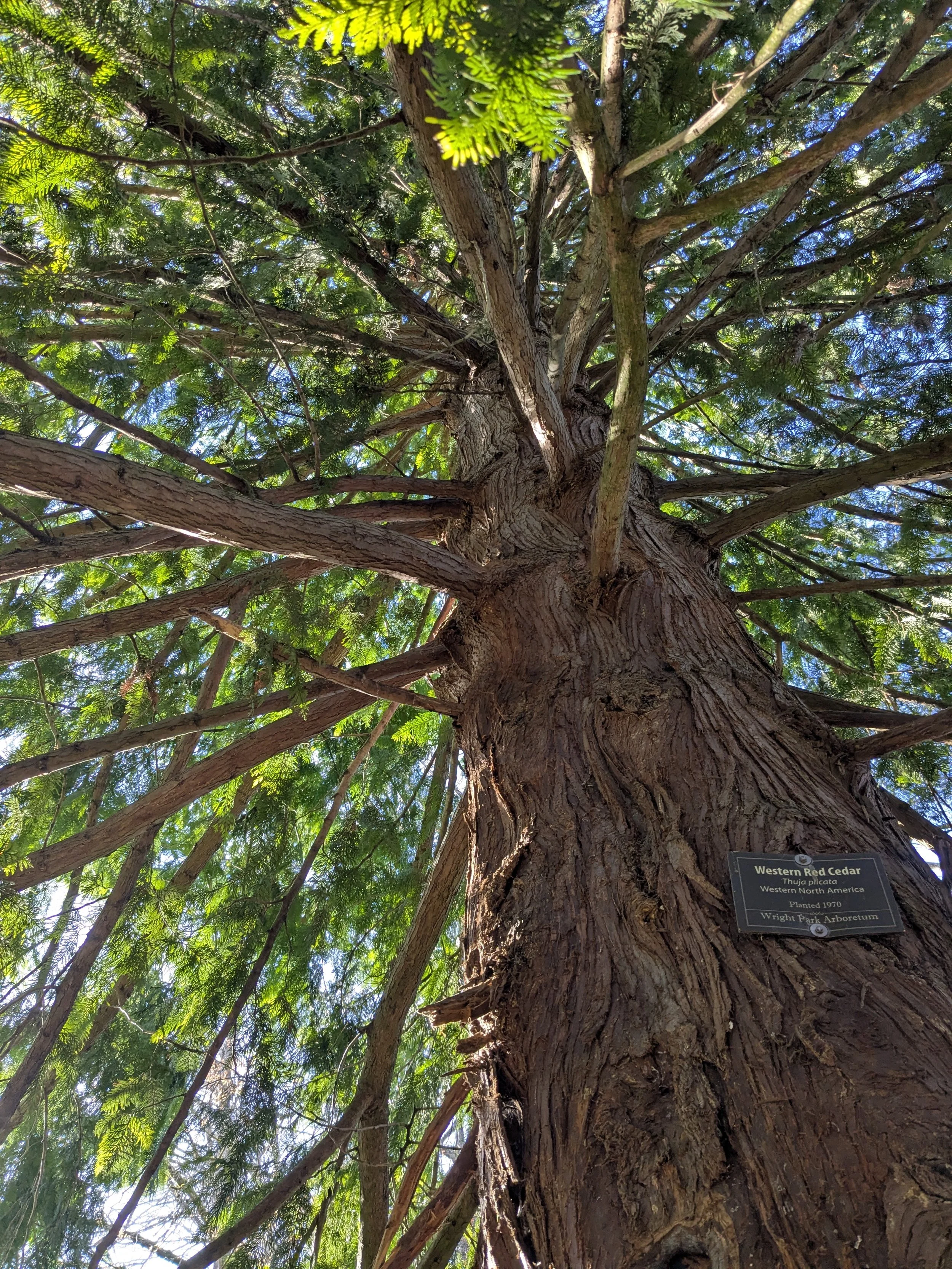
There is no tree more important to the history and culture of the Pacific Northwest, past and present, than the Western redcedar. It is known as “the tree of life” because of its important role in the lives of Coast Salish people, who use it for medicine, ceremonies, canoes and houses, clothing, and basket and rope weaving, and other cultural practices. Somewhere in Tacoma, we can imagine a Western redcedar that has stood long enough to witness the area’s evolution from serene old growth forest stewarded by the Coast Salish peoples, to colonization, to industrial revolution, through to the present day. This tree has seen things. It is a witness and its roots run far and wide.
The Western redcedar is not a true cedar. True cedars are native only to the mountainous regions of the Mediterranean and the Himalayas. The redcedar is more closely related to cypress, juniper, and other trees in the thuja family.
Cedar is a provider, but doesn't just provide by giving, it provides by witnessing. For the Coast Salish peoples, connection with the redcedar tree and its gifts are a way of growing and maintaining their traditional practices.
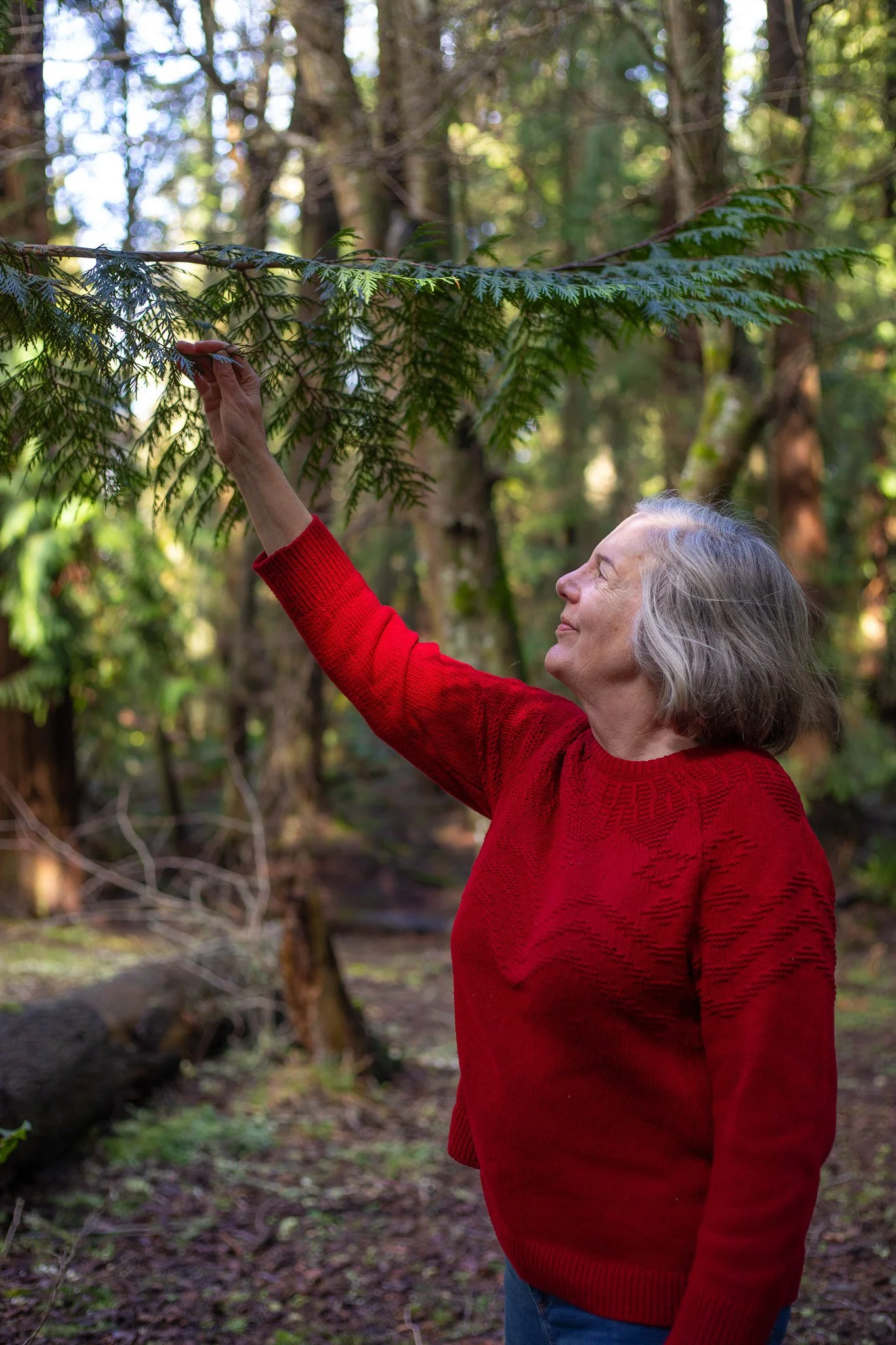
Janel next to a Western redcedar. Source: Julia Wolf
For Janel Krilich, Tacoma Tree Foundation Board member and resident, the Western redcedar is a lifeline to her home and history. “I always feel very rooted here. I belong to the Northwest, like the cedar tree.” Janel said. Janel grew up in North Tacoma, climbing three large redcedar trees in her backyard. When she was 30, she decided to move to the Midwest and started her career in public parks, but she continued to feel connected to Tacoma. During a visit home when she lived in Ohio, she formed one of her core memories of the forest canopy in the PNW:
“I was on the ferry from Tacoma to Vashon island and looked up. It was very foggy and misty and you could just see the tip of Point Defiance through the fog. All you could see was the forest: redcedar among Douglas fir, Western hemlock, and madrone. And to me, that was indicative of where we live. I pictured this land before colonization. I can pull up that image at any time. To me that's what the Pacific Northwest is, that's what Tacoma is.” As she reached her 40s she decided to move back, buying a home not far from where she grew up, with a large redcedar tree in the front yard.
Janel’s perspective of Tacoma is a rarer one for how long she has lived here. She lived in Tacoma before Tacoma had a distinct identity or sense of pride, and has witnessed the development of our local community and culture.
One salient moment of realization for her was during one of her first volunteer events for TTF: “I was one of the oldest volunteers there but I was talking to the other volunteers and would always ask them how long they had lived in Tacoma, and they were all transplants: it'd be three years, five years, seven years, but they were all so enthusiastic about Tacoma. And I was kind of shocked because I grew up here and so much of it is hidden, you really have to seek things out.”
The elusiveness of Tacoma is perhaps due to our city’s industrial history and the fact that it wasn’t designed to be a major destination for tourism or culture; it was designed to be a terminal city for the Northern Pacific Railroad and a hub of industry.
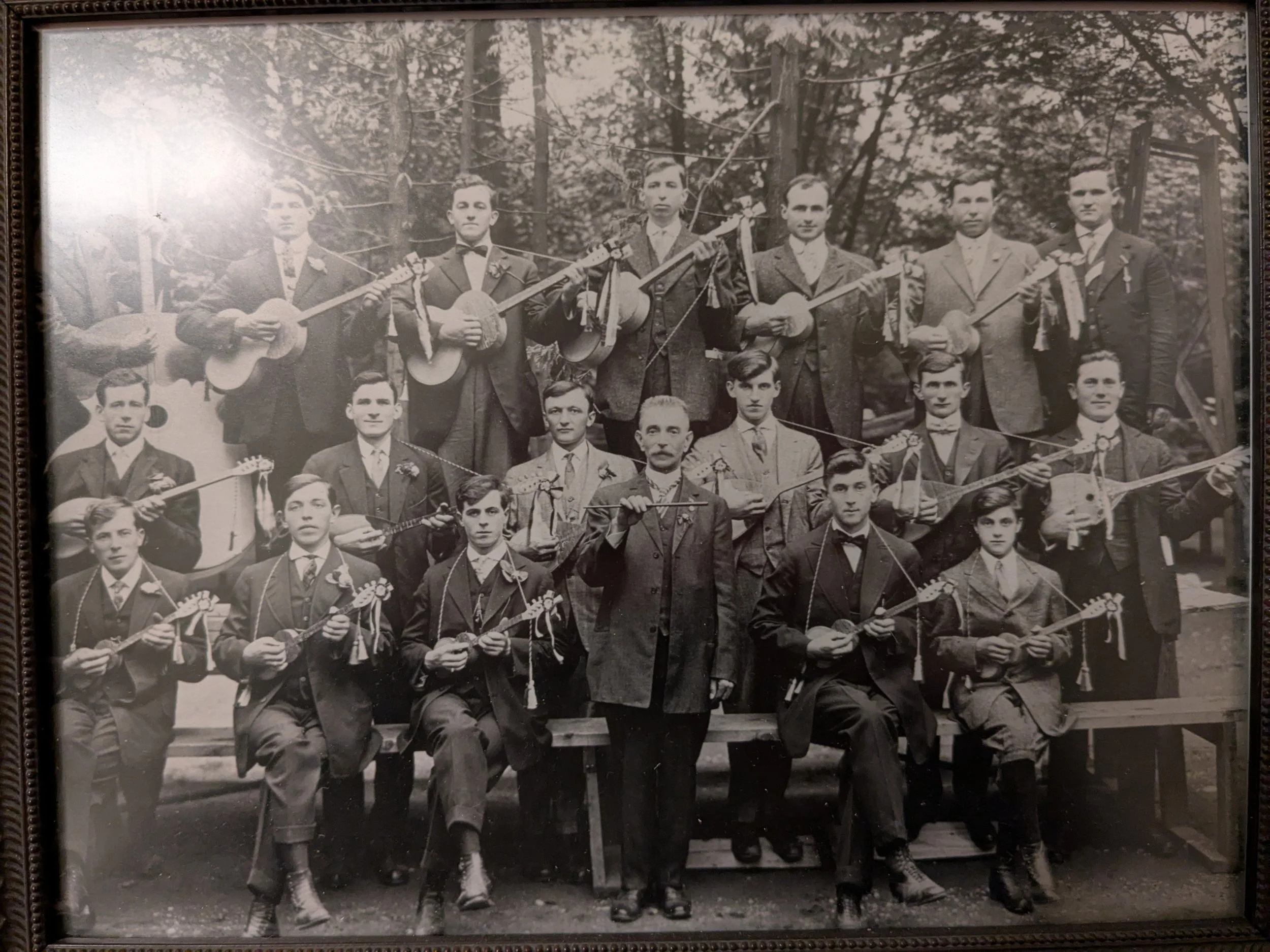
Janel’s Grandfather in A Band Source: Janel’s personal archive.
This vision that the settlers had for Tacoma made it a hub of industrial production, leading to the building of what would be called the ASARCO smelter in 1890, which processed heavy metals like lead, copper, and arsenic. It was among many other factories and smelters that contributed to the pollution of the Puget Sound area.
Imagine the redcedar witnessing the smokestack of the ASARCO smelter being built to 571 feet in 1917, spreading lead, arsenic, and other heavy metal residue far and wide around the Sound. The presence of the smelter and other factories, lack of environmental protection regulations, and lack of understanding of the danger posed by industrial waste, led the government to declare Ruston, Commencement Bay, Thea Foss Waterway, and the Tideflats a superfund site that is still being cleaned and monitored by the EPA.
Alongside the redcedar, Janel and her family witnessed this period. “My father’s first job out of the army was working at the smelter and when we would drive around Ruston he could point out houses that his guys that worked at the smelter built themselves.” Janel’s grandfather and three of his brothers emigrated to Tacoma from Croatia around 1918. Here, they grew their families, built their own houses by hand, and opened two local grocery stores in the North End, one of which is still standing but no longer functions as a grocery store.
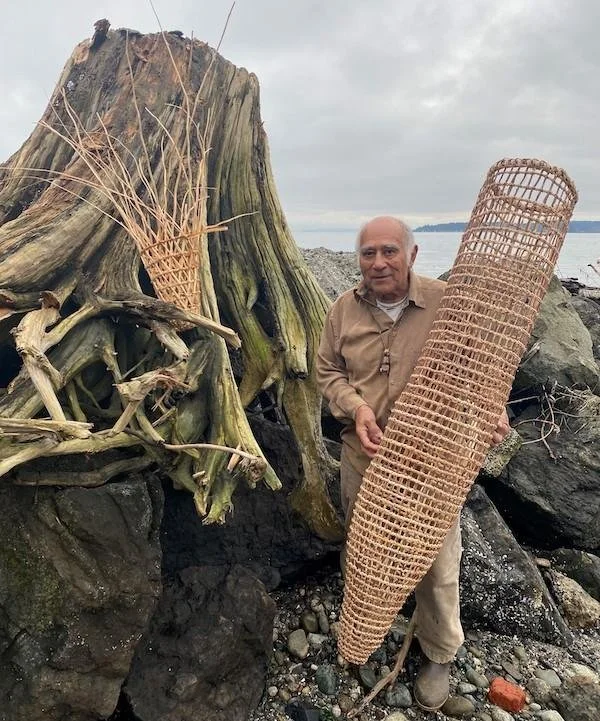
Carriere-finished-basket Source: National Endowment for the Arts Website
Things in Tacoma started to change in the early 1990’s when the ASARCO smelter finally closed and the facility was demolished. While industry in Tacoma was slowing down, there was still the problem of the city’s underdevelopment and severe pollution issue. Janel recalls Thea Foss Waterway during this time: “There wasn’t a walkway or a path. There weren't any buildings on the water. There weren't any boats there, it was a neglected and forgotten corner of the city…It was a smelly mess.” Now the waterway is one of Janel’s favorite spaces in all of Tacoma, especially for how she has gotten to see it change for the better over time. Planting trees, especially natives like Western redcedar, along the Waterway has been a critical part of making the space habitable again for both humans and animals, reducing air and water pollution, and rehabilitating this previously neglected and polluted place.
Redcedar wood is resilient against pollution and resistant to rot. Once bark, wood, and roots are harvested from the tree, they hold their shape, long enough for archaeologists, artists, and crafts people to find ancient preserved cedar baskets, totem poles, and clothing to be recreated by artists like Ed Eugene Carriere, Qwalsius also known as Shaun Peterson, and Taylor Dean, among many others. Cedar helps us to remember what is important and the knowledge we need to protect those things.
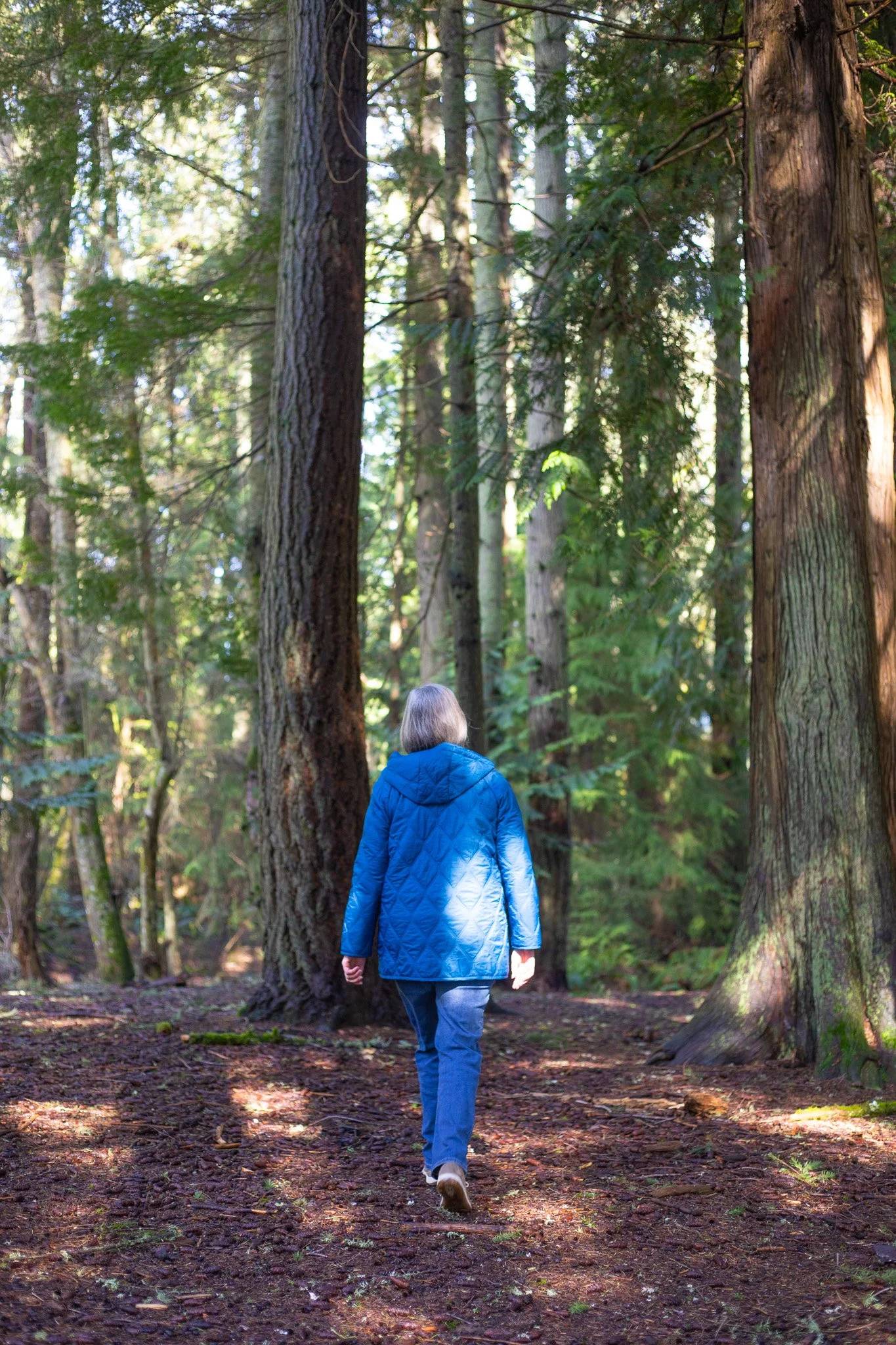
Janel among Western redcedars Source: Julia Wolf
Janel remembers a much darker version of Tacoma that could be our reality now had it not been for the growing recognition of environmental protections decades ago. It's not much of a stretch to suspect that what she witnessed informed and drove her passion for building and protecting public greenspace throughout her career and tenure as a TTF Board member.
Janel’s journey as a Board member began after she took a trip to Atlanta Georgia: “ They have a really cool trail system within the city. A rails-to-trails project called the Beltline and they’ve built 20 plus miles of trail right through the middle of the city. I went with my friend on a guided tour of a new portion of the trail and the docent was from Trees Atlanta. I thought ‘that is the coolest thing, too bad Tacoma doesn’t have something like that’” After arriving back in Tacoma Janel told one of her co-workers about Trees Atlanta “who happened to be Jess Stone, the President of the Tacoma Tree Foundation Board at the time. She’s the one who brought me in.”
Since joining, Janel has chaired the Development Committee, supporting the growth of the organization’s fundraising efforts in crucial ways. She constantly supports countless volunteer events, potting parties, planting days, and is always helping TTF forge new community partnerships to ensure long-term stability. As with the redcedar, it is Janel’s rootedness and commitment to witnessing Tacoma and the connections that happen between people and nature within our community that make her an integral part of our community. We couldn’t do this work without her!
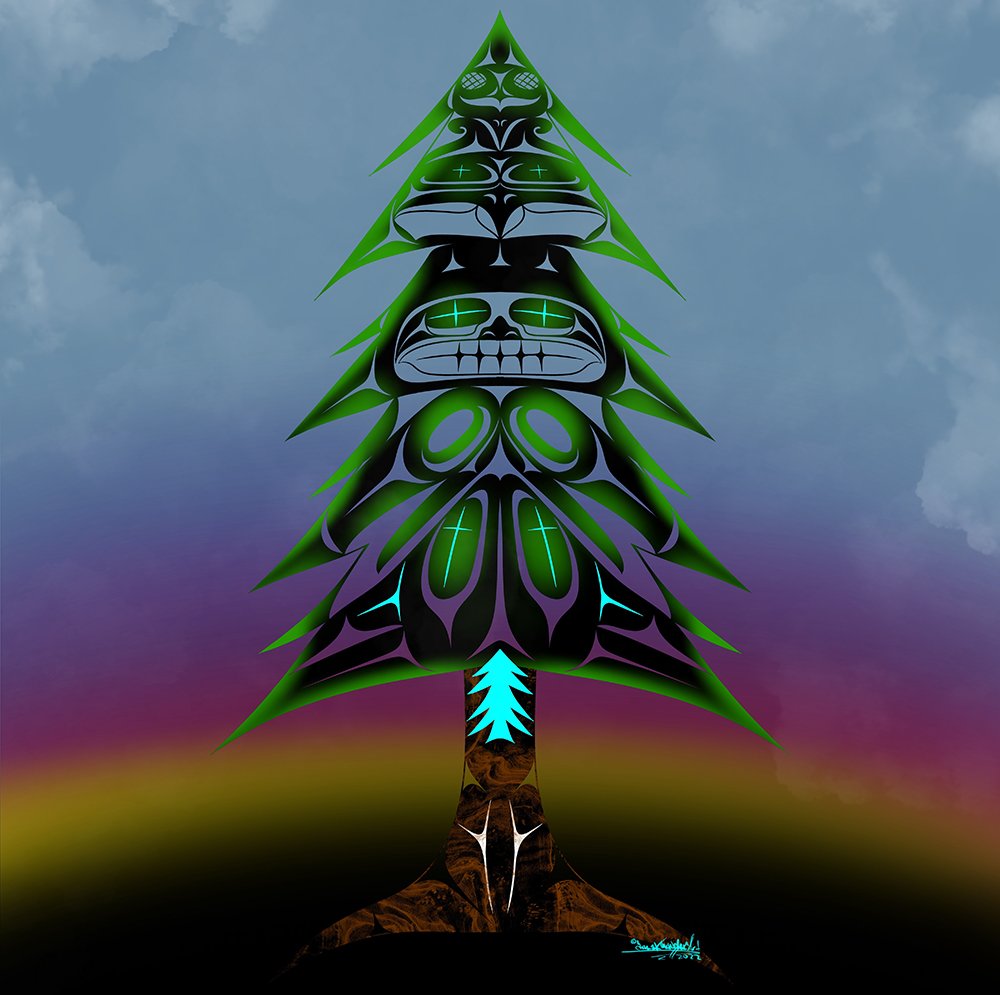
Emerald Shores 2022 Source: Urban Forest Symposium
As restoration efforts in Greater Tacoma grow, so does the presence and prominence of the Western redcedar in our local culture. The redcedar is more widely recognized as a central tenant of Tacoma, and an important connection to our identity and heritage. Today, many Western Redcedars can be found within Tacoma’s parks and neighborhoods including along Thea Foss and Ruston Waterways, Swan Creek park, and Point Defiance.
Currently there is a project tracking and studying Western redcedar dieback in the Pacific Northwest called Forest Health Watch. This is a critical way for community members to support redcedar restoration, research, and to connect with one of our most important native trees! Learn more about getting involved with the project here.
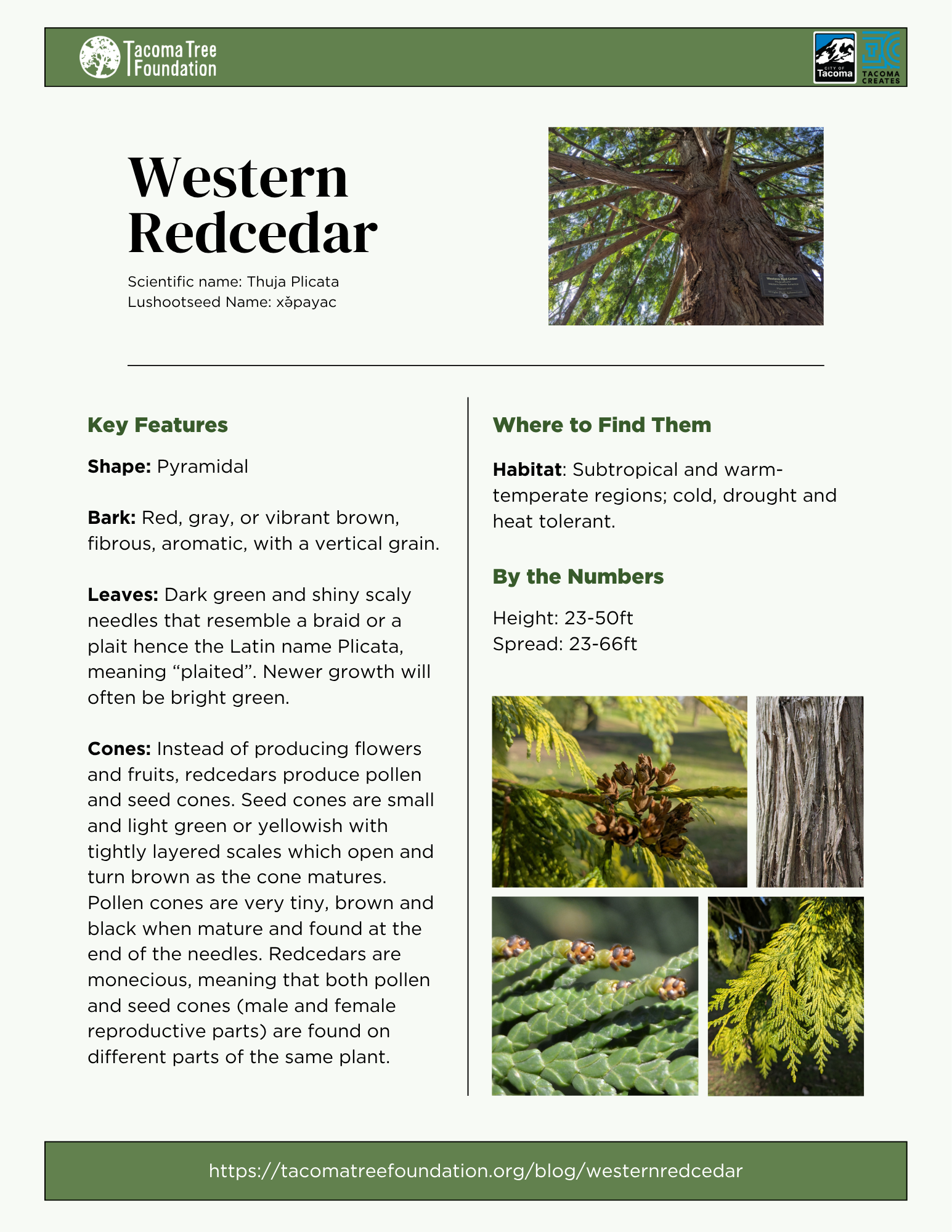
Download our tree ID guide so you can spot western hemlock trees around your city.