Trees of Significance: A Pioneer with Thorns
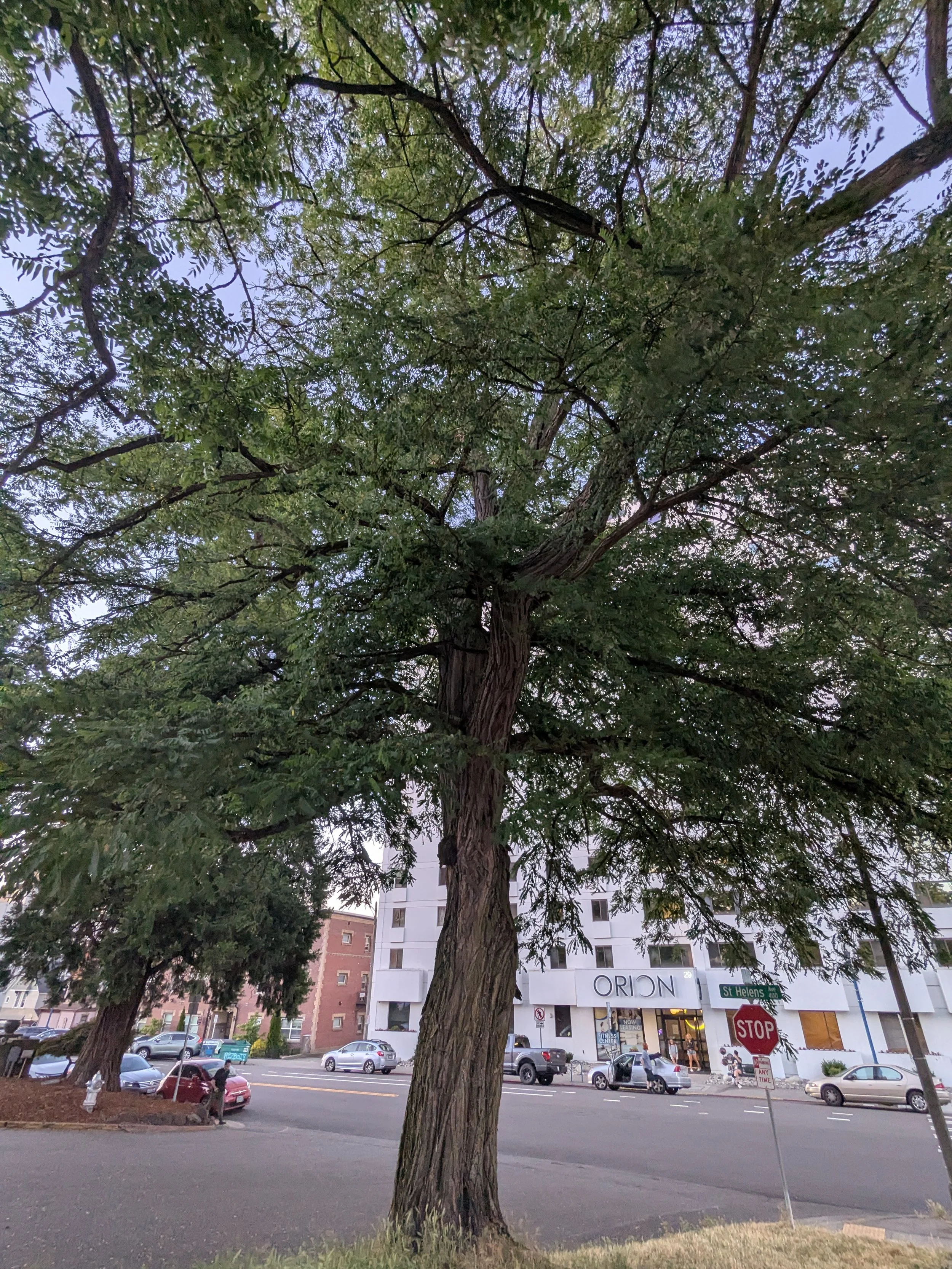
Black Locust at Norton Memorial Park. Source: Eden S.
The black locust tree is a controversial, non-native species in the Pacific Northwest, classified as a class-C noxious weed by the Washington State Weed Control Board. Even so, the black locust fills unique niches in our urban forest and has a lot to teach us about what it means to pioneer, persist, and be prickly.
Jess Stone is a natural resource steward with Pierce County Parks, and was the first Tacoma Tree Foundation Board President. Jess has a deep relationship with the controversial black locust tree. Jess’s role with Pierce County is to manage different parks and natural areas throughout the county. To accommodate her busy schedule, we met online. My first question was where she got to know the black locust, and she explained she “really became familiar with black locusts as an invasive species. It's one that gets called out a lot, especially in the western U.S”
The black locust is originally native to the Ozark and Appalachian mountains in the eastern United States, but it is naturalized in many places, including across Europe and Asia. Jess was attracted by the tree’s “ interesting crooked shaped system, and its beautiful gray bark.” She notes how it “has a structure that you just don't see in other trees" in our area. The tree’s scientific name, Robinia Pseudoacacia means false acacia, pointing to the tree’s unique tall branching structure like that of an acacia tree. However the black locust is part of the pea family and not a true acacia. Jess admires how “There's an airy elegance to it, almost like lace.”
In late May, I visited the Fort Steilacoom dog park where there are a number of black locust trees that provide shade and a break from the flat field landscape along with the native Garry oaks. I lay on a picnic blanket, looking up at the sun coming through the black locust canopy and was reminded of a doily like those my great aunt used to make. Later I wondered what black locusts were doing in the dog park. Jess helped me find the answer: “You see black locusts planted in locations where these original homesteaders settled. You see them a lot in Lakewood and Parkland.”
When Jess and I first made plans to do this interview she had told me this story about how she began identifying with the black locust: “ I had an interview question years and years ago–a personality one where they asked the question just to see where your creative mind goes. ‘Jess, If you were a tree, what kind of tree would you be, and why?’ I used the example of redwoods. That's where I did all my Master's work. I talked about the redwoods and the characteristics and the embodiment of that and my personality, and it felt like this noble, wonderful thing. And then afterward, I was really honest. If I were a tree, I'd be a black locust!”
Jess says she’s “got some great qualities. Pretty and tough, but really I'm fairly thorny. I will spread and get to places and into stuff you don't want me to.” Jess describes herself as a thorny and an unwanted spreader. But from her work on local climate initiatives and in working to preserve our natural greenspaces, I know that these qualities align well with her role as an advocate and resource steward. They come out of passion and care for all the species in her community. Much like the black locust does.
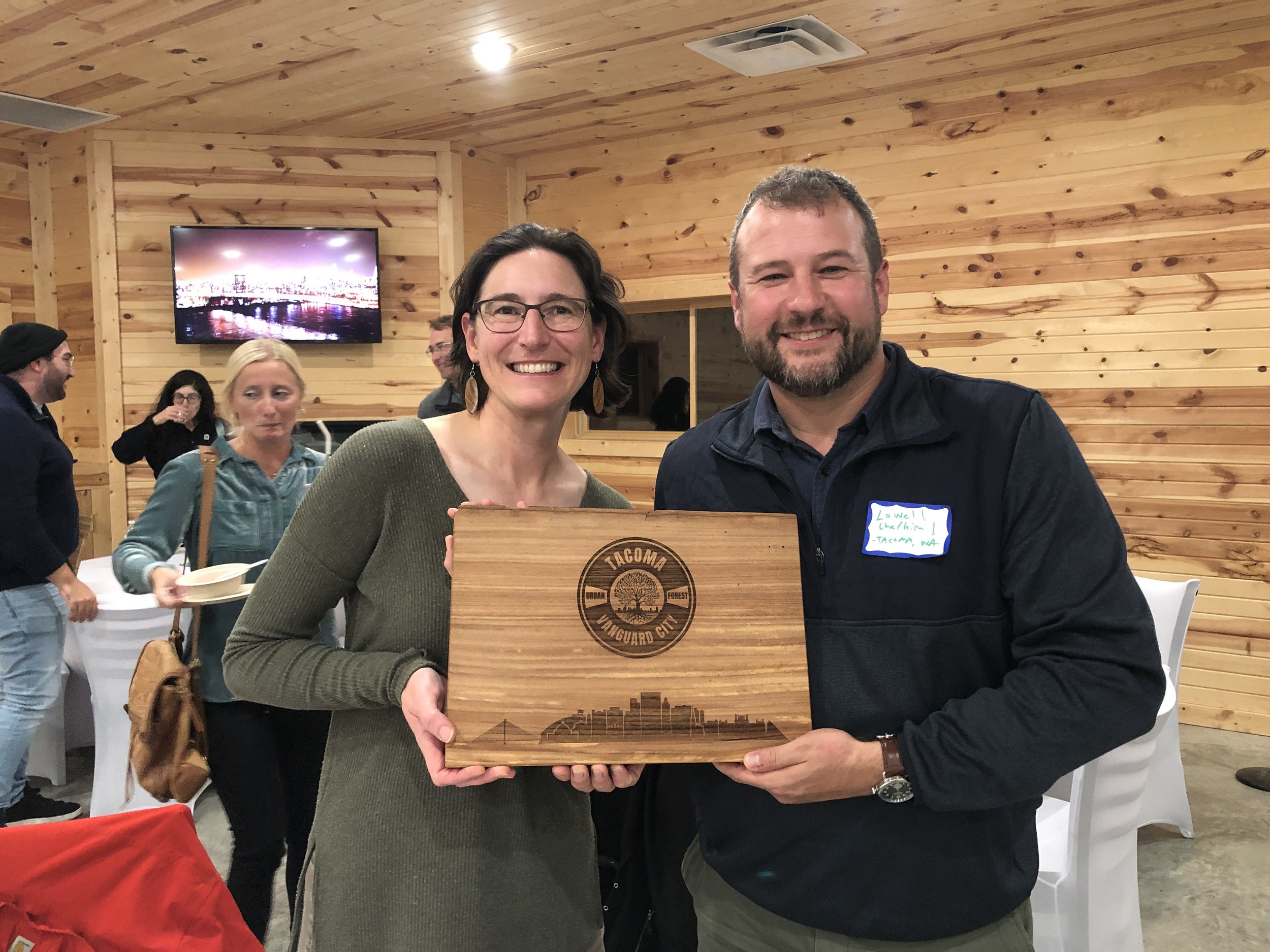
Jess Award with Lowell Source - TTF Archives
However, few people might see Jess’s and the black locust’s qualities this way, and may prefer to see them both as nuisances, invasives, or prickly. Jess and the tree know this.
“I've never planted black locust nor is it likely in the near future that I ever will. I would use its nicer, older sibling, the honey locust.” Honey locusts are tall, with a lacy canopy like the black locust, but are known for their height, lack of thorns–except on native southern honey locust which are known for their massive thorns,–and being one of the most pollution tolerant trees in our urban forests, next to ginkgo trees. Honey locusts don’t have a spreading habit like black locusts, so you’re more likely to find a lone honey locust rather than in a stand, making it more suitable for urban spaces. To be sure, though, black locusts do serve a purpose in our urban forests—one that is often overlooked.
Jess learned of the importance of this tree when she began working with the beekeepers. They brought a completely different perspective on a tree that Jess would have just taken a chainsaw to and injected with herbicides without hesitation. Jess worked with the beekeepers association to address the issue of habitat preservation for urban bees and pollinators. Sometimes pollinator habitat is not the intact, full-of-natives ecosystem we would like it to be. Sometimes it is made up of introduced species that take root in disturbed, polluted, or otherwise less than ideal conditions, like blackberry, butterfly bush, and black locust, all of which produce flowers, an important food source for pollinators. “These [invasive] plants, they're all wildlife has to survive on” Jess points out.
All they have, for the current moment, that is. Black locust is a pioneer species in its native habitat, meaning it is shade intolerant, fast growing, and one of the first trees to start growing after a disturbance, like a fire, landslide, pollution, or urbanization. It is also a nitrogen fixer, meaning it transforms nitrogen in the air and soil that cannot be accessed by most plants into accessible nitrogen compounds. Nitrogen is foundational for plant life and well-being. Without it, plants would not be able to photosynthesize, reproduce, or grow. Being both a pioneer species and a nitrogen fixer, we can think of black locust as a species that performs the essential prep work for making a forest livable again by cultivating a nutrient rich soil and providing shade to species that don’t thrive in full sun.
Jess explains that black locusts “are beautiful shade trees, and they are survivors, so they will take to soils and conditions that our native species will not, especially after a significant disturbance. [They are] filling the gaps in our urban forest where we would like to have native plants but they have a hard time growing.”
When considering removal of an invasive species in Pierce County, Jess has learned to ask herself and her team a series of questions about the particular “invasive” or introduced plant–sometimes a black locust–in question: “Are you causing a problem? Are you spreading? Are you getting where you're not supposed to? Are you providing the benefits? Will I make the area worse by removing you?”
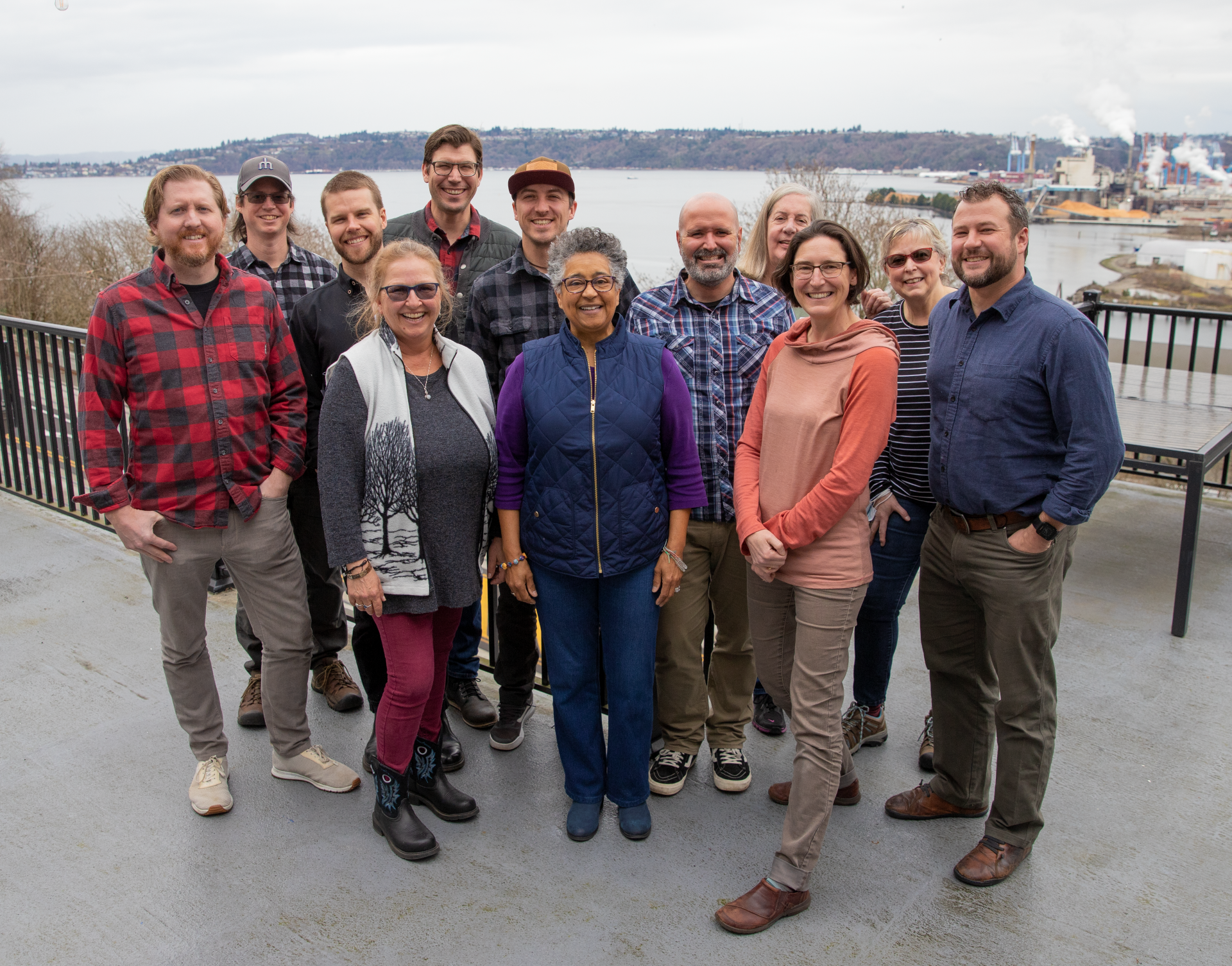
First TTF Board. Source: TTF Archives
Thinking this way has really helped her to make the best decisions in her role as a Natural Resource Steward. “It is a phenomenal job. It is wonderful and sometimes, you gotta take a step back and look at the amount of responsibilities that are on you to do the right thing and try to take care of these natural areas.” The hardest part of Jess’s job is figuring out how to both protect natural spaces and bring people into them at the same time. It is critical that community members feel welcome in natural urban spaces and parks because “if they are not getting out there and connecting with nature, then you're going to lose nature [natural spaces] because you're losing that appreciation.” This is where it becomes clear that human relationships with nature must be cultivated and supported in order for entire urban ecosystems to thrive.
Jess seems to have known this for a long time. I think it could be one of the reasons TTF’s founder, Sarah Low, chose Jess to lead the first Board of Directors. Our organization has been able to grow rapidly over the last 8 years due to people like Jess who helped us get our start. Jess offers an interesting reflection on her time as Board President when I ask about her relationship to the foundation now: “Success is not one person, and if I were to gauge success in any way, it's not about what I've done, it's about the things I've hopefully set in motion that others can do better.” Jess certainly helped set things in motion, and in this way, I see that Jess fulfills a similar role to the black locust in our organizational ecosystem: She is a pioneer, helping to create and gather the foundational knowledge and practices that provide a solid structure which others have now taken over. If Jess is a black locust, she helped provide a canopy under which the rest of us have been able to grow.
Jess continues to serve an important role in relation to TTF as our partner at Pierce County Parks, working with us to put on large tree shares like Green Blocks: Parkland. Beyond her official roles, she continues to practice pioneering work in our local environmental protections sector and doesn't plan to stop. She tells me: “When I retire, I want to be that person showing up at every Council Meeting, every government meeting, taking notes, and speaking out.” This is where her toughness, her thorns, and her propensity to “spread and get to places where I'm getting into stuff you don't want me to” like the black locust become critical skills for change-making. “You need to be prepared to go into those hard conversations, or you need to be prepared to get into places where you may not always be welcome or appreciated.”
In closing, Jess offers a final reflection on her connection with the black locust: “I think the black locust really represents a lot of professional growth for me […] learning about trees and systems and having to change your thoughts, having to change your opinions. Learning that you cannot be firmly black and white, that there are shades of gray. You have to be flexible. You have to be adaptive. And know that you are not always right.” These are some of the most important things we can take away from Jess’s connection with the black locust. Her story demonstrates that making change requires persistence and prickliness, especially when you are trying to make change in difficult circumstances, but also willingness to change your perspective and approach.
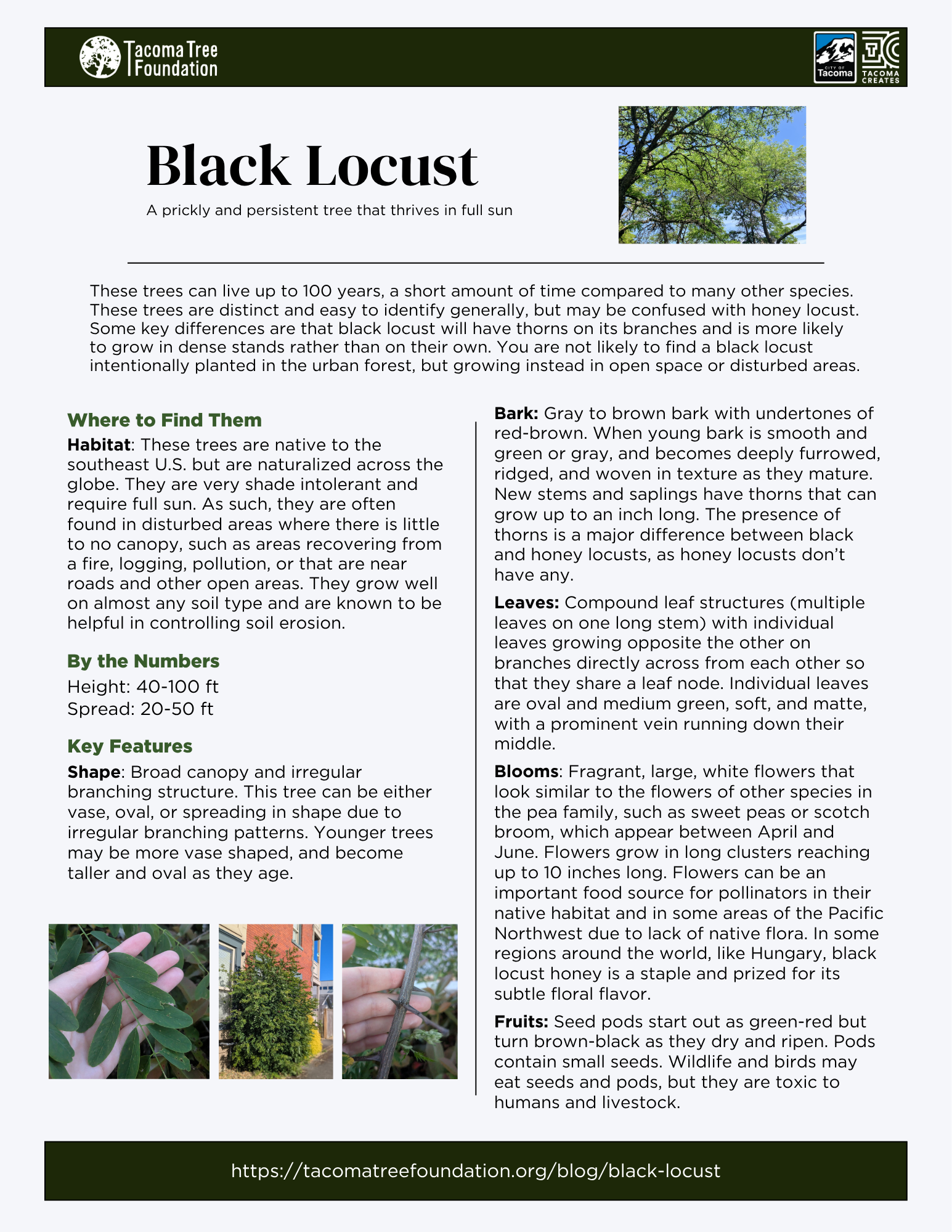
Download our tree ID guide so you can spot western hemlock trees around your city.